For a business evaluating wearable health technology, an ECG Health Smartwatch can offer more than a polished screen. It can capture a single-lead electrocardiogram, track everyday activity, and give users a clearer view of selected heart-rhythm patterns. The value is practical. A manager can compare battery life, app usability, comfort, data handling, and support before choosing a device for staff or customers.
Cardiologist and digital-medicine researcher Eric Topol has written, “The future of medicine is the future of health.” That idea fits workplace wearables, but it needs careful interpretation. An ECG feature may help a user record a tracing during symptoms; it does not replace a clinician’s assessment. Readings can be incomplete, confusing, or affected by movement. That matters.
For business buyers, the strongest case is not a dramatic promise. It is a useful tool, thoughtfully introduced. Picture an employee checking a watch after a brisk walk, then reviewing the recording with a qualified healthcare professional when appropriate. Clear guidance, accessible training, and transparent privacy practices build trust. So does admitting what the device cannot do. A smartwatch alone will not fix poor health habits or a weak wellness program. Still, a well-chosen ECG Health Smartwatch may support more informed conversations and help a company offer a tangible, everyday health resource. The details deserve scrutiny.
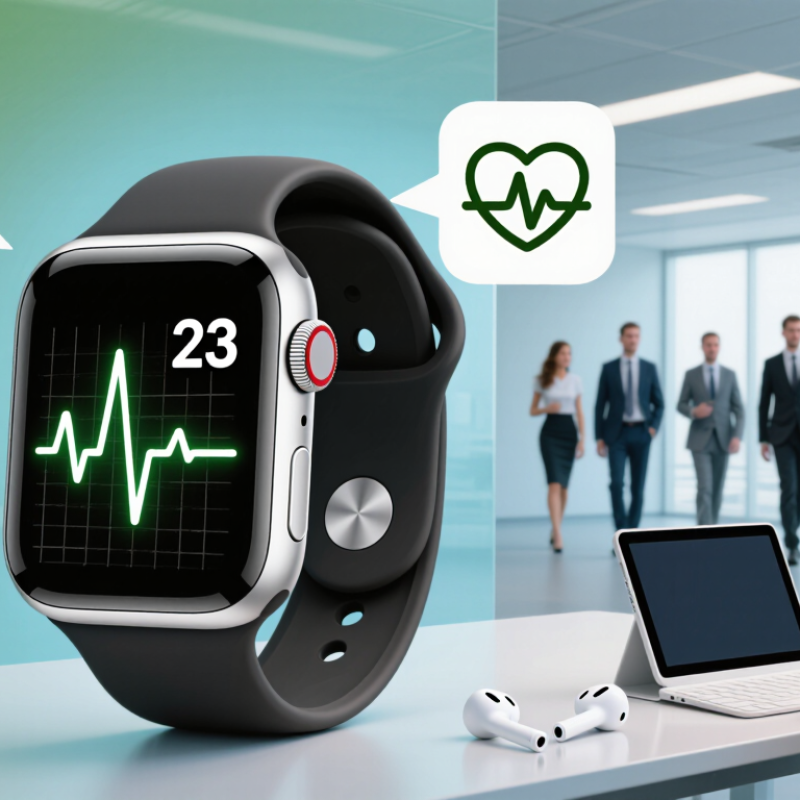
An ECG health smartwatch records the heart’s electrical activity through sensors touching the skin, often while a person holds the watch with a finger. The reading forms a brief, single-lead tracing rather than the multi-lead ECG used in many clinical settings. It can show heart rate during that recording and may flag patterns that could suggest an irregular rhythm. Useful, but limited.
For a business, this information can make wellness conversations more concrete. A staff member might notice a faster-than-usual pulse after climbing stairs, then compare it with a calm reading later. Results depend on fit, movement, skin contact, and timing. A loose strap or a moving hand can create a poor tracing. The watch does not diagnose heart conditions, and a normal result cannot rule them out.
Many devices also track pulse continuously with optical sensors, but that is not the same as an ECG recording. Some include blood oxygen estimates or sleep and activity data; availability varies by device. These measures can help users spot patterns, not explain their cause. A sensible workplace approach protects personal health data and avoids treating readings as performance scores. One imperfect reading may be noise, or it may prompt a person to seek professional advice.
An ECG smartwatch measures electrical signals linked to the heart’s rhythm. The wearer usually rests an arm and touches an electrode on the watch with a finger from the other hand. Electrodes at the watch’s back and side detect tiny voltage differences across the skin. The device turns those signals into a short waveform, often from a single viewing angle rather than the several angles used in a clinical ECG.
Keep still. A loose strap, movement, or dry skin can make the trace harder to interpret. Depending on the device, a recording may take around 30 seconds. Software can flag patterns such as a possible irregular rhythm, but that flag is not a diagnosis. An ECG smartwatch also cannot rule out a heart problem or replace medical assessment. Readings may be unclear, and that limitation deserves plain instructions, not fine print.
For a business, the practical question is how staff will use and support the feature. A brief demonstration can show employees where to place a finger and how to save a reading. Ask what health information is collected, who can access it, and how long it is retained. These details matter in workplace settings. Even with clear guidance, some people may find the process awkward or the results worrying. Plan for questions, and direct health concerns to a qualified healthcare professional.
For occupational health teams, ECG smartwatches can support voluntary check-ins for staff working alone, travelling, or on rotating shifts. A worker might record a single-lead ECG after noticing palpitations, then share the trace with a clinician for review. This does not replace diagnosis or emergency care. Keep participation private and separate from performance assessments; otherwise, staff may avoid using the device.
Evidence also sets realistic expectations. A 2019 New England Journal of Medicine study followed 419,297 participants using smartwatch-based irregular-pulse notifications. About 0.52% received a notification. Among participants who returned an ECG patch, 34% had atrial fibrillation detected; when a notification coincided with patch monitoring, its positive predictive value was 84%. These were screening results, not proof that every alert signals disease. For clinics and employee wellness providers, the practical use case is a consent-based pathway: capture a reading, explain its limits, and arrange appropriate clinical follow-up. The workflow can be awkward. Devices need charging, workers need clear instructions, and some recordings will be inconclusive. That friction deserves attention before a company expands a pilot.
For a business, choosing an ECG health smartwatch begins with a clear use case. Will employees use it for personal wellness, or will trained staff review readings? Check whether the device records a usable ECG trace, explains how to take a reading, and flags movement or poor skin contact. A short setup guide matters when people are checking readings between meetings or during a shift. Ask how the device handles irregular results, too; a watch should not present a wellness reading as a medical diagnosis.
Compare comfort, battery life, and fit across different wrists. A watch that feels bulky may stay in a drawer. Review the companion software, data export options, access controls, and storage practices before purchase. If readings will inform workplace programs, clarify who can view them and how long they are retained. Test devices during ordinary workdays, not only in a showroom. One small detail can be missed: users may need to sit still and keep their arm supported for a steadier recording.
Tips: Try a sample reading in a quiet room, then repeat it after normal movement. Check whether the instructions make sense without staff assistance. Readings can vary, and that deserves honest discussion. Use ECG features as a prompt to seek qualified clinical advice, not as a substitute for it.
Compare the number of ECG leads captured in a typical smartwatch recording with a standard clinical ECG.
What this means: Most ECG smartwatches record a single lead, while a standard clinical ECG uses 12 leads. Lead count indicates the number of electrical viewpoints—not diagnostic accuracy. When evaluating a device, also consider clinical validation, regulatory status, data export, and workflow integration.
An ECG smartwatch program needs more than a device order. Plan a small pilot across different roles, shifts, and wrist sizes. Provide clear setup instructions, charging points, and time for staff to ask questions. A reading can be affected by movement, loose fit, or poor skin contact, so employees need guidance on repeating a measurement and recognizing when a result is inconclusive. The watch is not a diagnosis. Staff should know whom to contact if they have symptoms, regardless of what the screen shows. Small details matter. Some employees may not have a compatible phone, and participation can be uneven. A rollout plan should account for that.
Data handling deserves equal care. Explain what is collected, who can view it, and how long it is retained before enrollment begins. Use role-based access, secure transfer, and clear separation between personal health data and routine performance reviews. Avoid collecting more than the program needs. That sounds tidy. Real workplaces are messier. Decide how employees can correct records, withdraw, or request deletion where applicable. Integration with existing wellness or occupational health systems should be tested with sample data first. Confirm timestamps, units, and alert routing, then document who responds to flagged readings. A dashboard is not a care team. Keep a human review process, and make its limits visible to staff.
| Business Dimension | Workplace Requirement | Relevant ECG Smartwatch Capability | Implementation Consideration | Recommended Readiness |
|---|---|---|---|---|
| Workplace deployment | Device allocation and enrollment | Centralized user assignment, device inventory, charging rotation, and access-role management | Define ownership, replacement procedures, device-return rules, and support responsibilities before rollout | Operationally ready |
| ECG measurement workflow | Consistent collection of spot measurements | Single-lead ECG capture typically requires skin contact and a short, user-initiated recording | Provide instructions for correct fit, stillness, clean contact points, and repeat measurements when signal quality is poor | Training required |
| Clinical boundaries | Safe use in employee wellness programs | ECG readings can support wellness monitoring and screening workflows but do not replace professional diagnosis | Use clear disclaimers, escalation procedures, and licensed clinical review where medical decisions may be involved | Governance required |
| Data minimization | Collect only information needed for the stated purpose | Configurable retention of ECG traces, timestamps, heart-rate data, and device identifiers | Separate wellness data from employment decisions and establish documented retention and deletion periods | Policy required |
| Privacy and consent | Transparent employee participation | Consent records, privacy notices, optional participation, and role-based access can be incorporated into the program design | Explain what is collected, why it is collected, who can access it, and whether participation affects employment in any way | Required before launch |
| Security in transit | Protection during device-to-system transfer | Use encrypted Bluetooth or network connections and authenticated application interfaces | Verify encryption protocols, certificate handling, session controls, and vulnerability-management practices with the supplier | Technical validation |
| Security at rest | Protection of stored health information | Encrypted storage, access logging, backup controls, and configurable administrative permissions | Confirm key-management responsibilities, audit-log availability, backup locations, and data-deletion workflows | Technical validation |
| Regulatory alignment | Compliance with applicable privacy and health-data rules | Program controls can be mapped to requirements such as GDPR or HIPAA when their scope applies | Applicability depends on location, organization type, data use, and the role of each party; obtain legal and compliance review | Legal review |
| System integration | Connection to existing health or workforce platforms | Data exchange may use documented APIs, webhooks, CSV exports, or healthcare interoperability standards such as HL7 FHIR | Define field mappings for user ID, measurement time, ECG result, signal quality, consent status, and audit metadata | Integration planning |
| Identity management | Controlled employee and administrator access | Single sign-on, multifactor authentication, role-based access, and account lifecycle controls | Connect access removal to the organization’s joiner, mover, and leaver process | Recommended |
| Data quality | Reliable readings for meaningful follow-up | Signal-quality indicators, measurement timestamps, device status, and repeat-capture workflows | Monitor incomplete readings, failed synchronization, duplicate records, and unusual device usage patterns | Quality monitoring |
| Connectivity resilience | Use in offices, remote sites, and travel environments | Temporary local storage or offline capture may allow synchronization after connectivity is restored, depending on system design | Test Bluetooth range, mobile pairing, network outages, time synchronization, and data recovery procedures | Pilot testing |
| Employee experience | High adoption with minimal disruption | Wearable form factor, guided measurement steps, reminders, and mobile access can reduce workflow friction | Offer accessibility support, multilingual instructions, and a non-punitive help channel for technical issues | Adoption focused |
| Operational reporting | Program-level insight without exposing individual health details | Aggregated dashboards can show enrollment, measurement completion, device uptime, and support volume | Apply minimum-group thresholds and suppress small-cell results to reduce re-identification risk | Privacy control |
| Vendor and service continuity | Long-term availability of devices and data | Exportable records, documented APIs, service-level commitments, and defined support channels | Include data portability, incident notification, end-of-service transition, and secure destruction terms in contracts | Contract review |
It detects small electrical signals related to heart rhythm and turns them into a short waveform. Many watches record from one viewing angle.
Rest your arm and touch the watch electrode with a finger from your other hand. Keep still; a recording may take about 30 seconds.
Movement, a loose strap, or dry skin can make the trace harder to interpret. A steady arm helps, though it may feel awkward.
No. Software may flag a possible irregular rhythm, but an alert is not a diagnosis. Share concerns with a qualified healthcare professional.
No. A normal or unclear reading cannot rule out a problem or replace medical assessment. That limit deserves clear instructions.
Staff might voluntarily record a reading after noticing palpitations, then share it with a clinician. Keep participation private and separate from performance reviews.
Review comfort, battery life, fit, instructions, data export, access controls, and storage practices. Test it during ordinary workdays, not just in a showroom.
In one large study, about 0.52% of participants received an irregular-pulse notification. Among participants who returned an ECG patch, 34% had atrial fibrillation detected. These figures describe screening, not certainty.
Demonstrate finger placement and show how to save a reading. Try it in a quiet room; then discuss what may make readings unclear. Some details may need rethinking.
An ECG Health Smartwatch can help businesses support proactive wellness by tracking electrical signals from the heart, alongside metrics such as heart rate, rhythm patterns, activity, sleep, and stress indicators. Unlike basic pulse monitoring, ECG functionality can provide a closer look at heart rhythm during specific measurements, helping users recognize unusual patterns and decide when professional medical guidance may be appropriate. The technology works through sensors built into the watch and its case, which record the heart’s electrical activity when the wearer completes a reading.
For organizations, potential use cases include employee wellness programs, occupational health support, fitness services, remote monitoring, and health-focused customer solutions. Before choosing a device, businesses should evaluate measurement quality, battery life, comfort, durability, software usability, reporting features, and compatibility with existing systems. Successful workplace deployment also requires clear consent procedures, secure data handling, limited access, transparent privacy policies, and reliable integration with approved health or wellness platforms. An ECG Health Smartwatch should complement—not replace—professional medical evaluation.